What Sets This Worm Apart
I'll be straight with you: when Wormax.io first crossed my desk, I dismissed it as another Slither.io clone. Same premise — you're a worm, you eat dots, you grow, you try not to die. We've seen this formula a hundred times since 2016. But after sinking about forty hours into it over a couple of weeks, I can tell you that dismissal was wrong. Wormax.io isn't trying to reinvent the snake game. It's trying to deepen it.
Developed by Elyland, a studio based in Cyprus, Wormax.io takes the core Slither.io loop and bolts on something that changes the entire dynamic: three active skills that unlock as you grow. Boost, Stop, and Ghost. These aren't passive power-ups you stumble across on the map. They're abilities you trigger deliberately, with cooldowns, with costs, with timing windows that separate competent players from great ones. And they completely transform how you approach fights, escapes, and map control.
The game also layers in a progression system — leagues, essence currency, an artifact shop — that gives your sessions a sense of direction beyond "get big, die, repeat." There's a mobile version on iOS and Android that's surprisingly solid, and Elyland has been consistently updating it since launch, adding new skins, sounds, and quality-of-life improvements as recently as 2026.
Editor's Note: I came to Wormax.io after months of Slither.io and Wormate.io. I expected to play for an afternoon and write it up. Instead, I found myself staying up until 2 AM grinding for league promotions and theory-crafting ghost-walk timing in the Discord. The skill system gets its hooks in you faster than you'd expect.
The Skill Trinity: Boost, Stop, Ghost

Everything about Wormax.io's competitive depth traces back to three skills. Let me break them down precisely, because understanding the unlock thresholds and costs is the foundation for everything else in this guide.
Acceleration (Boost). Unlocked almost immediately at 11 length points. Trigger with left-click or Q. When active, you lose 10 length points per second but gain a significant speed burst. This is your bread and butter — the tool you use to cut off fleeing worms, escape traps, and contest food piles. The mass cost sounds steep, but a single kill refunds far more than a few seconds of boosting will ever cost you.
Stop. Unlocked at 100 points. Hold W to freeze your worm in place. Sounds underwhelming, right? It's not. Stop is the most underrated skill in the game, and I'll spend a whole section on it because most players completely ignore it.
Ghost. Unlocked at 500 points. Press E to become invisible for five seconds. During that window, you can pass through other worms without dying. Five seconds doesn't sound like much, but in a game where a single frame of contact means death, five seconds of intangibility is an eternity. Ghost is the skill that separates the top of the leaderboard from everyone else.
Here's the critical thing: all three skills have cooldowns. You can't spam them. This means every activation is a decision, not a reflex. The best Wormax.io players I've watched aren't necessarily the fastest or the most aggressive — they're the ones who use their skills at moments that matter.
- 1. What Sets This Worm Apart
- 2. The Skill Trinity: Boost, Stop, Ghost
- 3. Mass Is Currency: The Boost Economy
- 4. The Stop Button Nobody Uses
- 5. Five Seconds of Invisibility: Ghost Walks
- 6. Hunting Giants: How Small Worms Kill Big Ones
- 7. Reading the Arena: Position, Zones, Escape Routes
- 8. The Corpse Economy: When Leaders Fall
- 9. Snake Game Bloodsport: Wormax vs Slither vs Wormate
- 10. Artifacts, Essence, and the League Climb
- 11. Voices from the Server: Community Wisdom
- 12. Final Words from the Arena Floor
Mass Is Currency: The Boost Economy
Let's talk about boost, because it's the skill you'll use most and the one most players waste.
Every time you boost, you're spending length. Ten points per second. That's not free. But here's the thing — mass in Wormax.io isn't a score, it's a resource. You spend it to make plays. The question isn't "should I boost?" The question is "is what I'm about to gain worth more than what I'm about to lose?"
Sometimes the answer is obvious. A fleeing worm with 2,000 points is boosting away from you? Spend 50 points to cut them off and you've just gained 2,000. That's a 40x return on investment. But what about the worm that's not worth chasing? The food pile that three other players are also contesting? The escape that might not work?
I've developed a simple rule that's served me well: boost to gain, never to maintain. If you're boosting just to keep moving fast, you're bleeding mass for nothing. Boost when there's a specific outcome — a kill, a food grab, an escape — that justifies the cost. Otherwise, save it.
There's also a psychological dimension. When you boost, other players hear it (or see the visual effect). A boosting worm looks aggressive, and aggressive worms attract attention. Sometimes the smartest boost is the one you don't take — let the other player think you're committed to a direction, then cut the opposite way at normal speed.
Pro Insight: The best boosters I've seen don't boost in straight lines. They boost into curves, using the speed to tighten their turning radius and wrap around opponents faster than the target can react. A straight-line boost is a chase. A curved boost is a trap.
The Stop Button Nobody Uses
Stop is the skill that makes Wormax.io genuinely different from every other snake game on the market. And almost nobody uses it well.
Here's what happens when you press W: your worm freezes. Completely. It doesn't slow down — it stops dead. For about two seconds, you're a wall. Other worms can still die by running into you, but you can't move.
Why would you ever want to stop moving in a game where standing still gets you killed? Because stopping lets you do something no other snake game allows: change the geometry of a fight instantly.
Picture this. You're being chased by a worm that's twice your size. They're gaining on you, cutting off your escape angles. You're running out of room. So you stop. Your worm becomes a solid barrier. The chaser, committed to their trajectory, either runs into you and dies, or swerves hard to avoid you — and in that moment of swerving, they expose their flank. You resume moving and cut them off from the other side.
That's the stop-bait. It's devastating when it works, and it works more often than you'd think because almost nobody expects it. Players in Wormax.io are conditioned to chase boosting targets, not stationary ones. When you stop, you break their pattern recognition.
Stop also has defensive applications. If you're caught in a tight space with multiple worms around you, stopping can prevent you from drifting into someone while you reassess the situation. It buys you a beat to scan the minimap and plan your next move. In a game that's all about momentum, sometimes the most powerful thing you can do is remove yours.
I'll be honest — stop has a steep learning curve. My first week of trying to use it, I kept freezing at the worst moments and getting surrounded. But once I started using it as a baiting tool rather than a panic button, my kill count jumped significantly.
Editor's Note: I polled the Wormax.io Discord about stop usage. About 70% of respondents said they "rarely or never" use the skill. The top-ranked players in the server? Every single one said they use it multiple times per match. That gap tells you everything about why stop matters.
Five Seconds of Invisibility: Ghost Walks
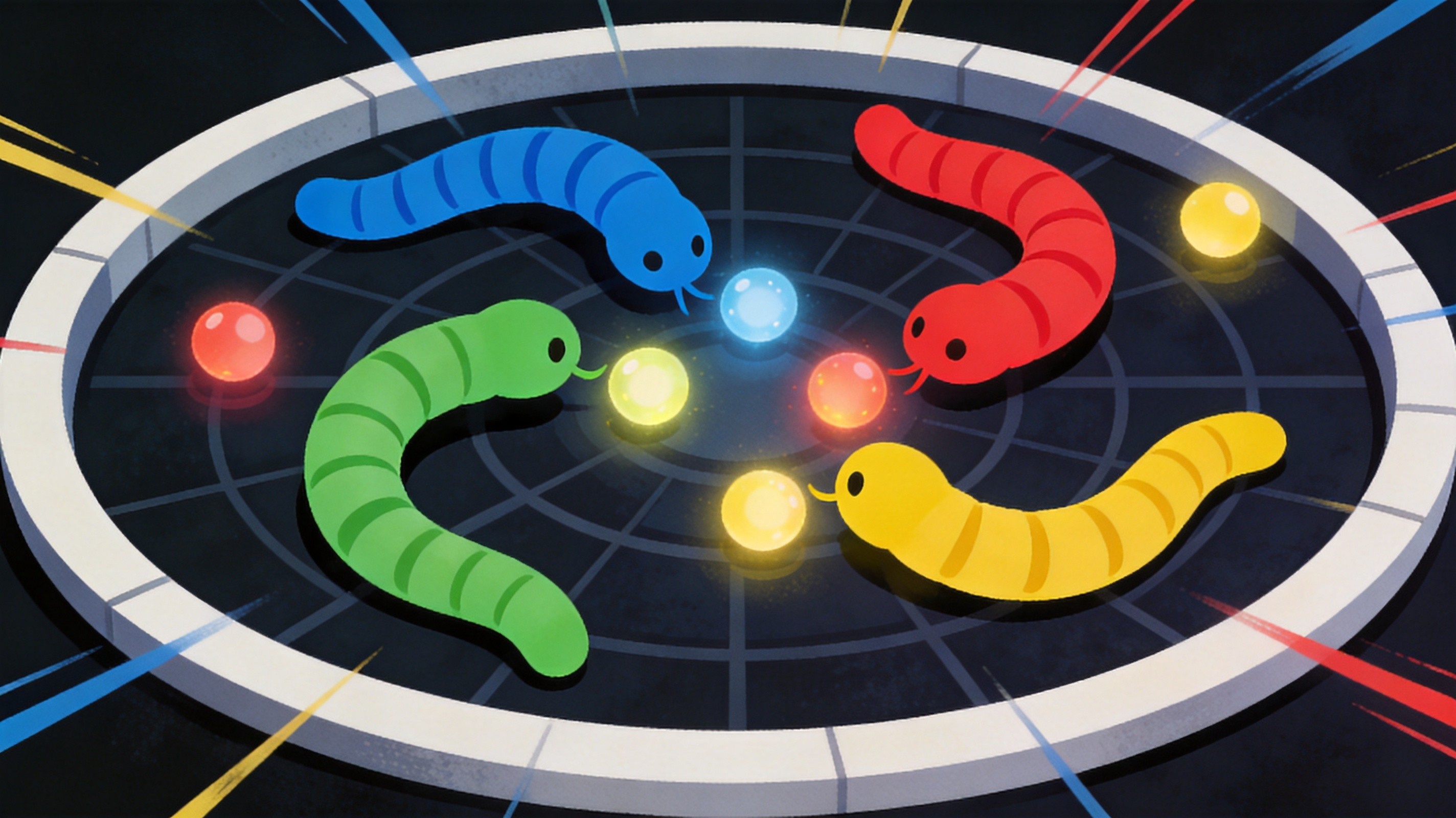
Ghost is the skill that makes top-tier Wormax.io play feel like a different game entirely. Press E, and for five seconds, you vanish from the minimap and can pass through other worms without dying. Five seconds. That's enough time to cross the entire center of the map, enough time to escape a three-worm ambush, enough time to position yourself for a kill that would be impossible any other way.
The unlock threshold is 500 points, which means you need to survive and grow for a while before ghost becomes available. This is deliberate — Elyland wants you to learn fundamentals before giving you the most powerful tool in the game. And it is the most powerful tool, by a wide margin.
Let me walk you through a scenario that happened to me last week. I was sitting at about 3,000 points — decent size, not dominant. Two larger worms had me cornered against the map edge. Normally, that's a death sentence. But my ghost cooldown had just finished. I popped it, walked straight through the larger worm's body, came out on the other side, and boosted to cut across both of them before the five seconds expired. One of them panicked, overcorrected, and crashed into the other. Two kills, one ghost activation.
That's the dream scenario. But ghost has subtler uses too.
Ghost as recon. When you're invisible on the minimap, you can move through contested territory without drawing attention. Use this to scout food-rich areas or track the movements of the server leader without them knowing you're there.
Ghost as escape. If you're surrounded, ghost lets you walk through the encirclement. No other snake game gives you this option. In Slither.io, being surrounded means you're dead. In Wormax.io, being surrounded means it's time to press E.
Ghost as ambush. Position yourself near a food pile while invisible. When a worm comes to feed, materialize behind them and boost to cut them off. They never saw you coming because, as far as their minimap was concerned, you weren't there.
The cooldown on ghost is long enough that you can't rely on it every engagement. This is important — it means you still need solid fundamental play to survive between ghost uses. A player who only succeeds when ghost is available isn't a good player. They're a player using a crutch.
Hunting Giants: How Small Worms Kill Big Ones
One of the most common questions I get from new Wormax.io players is some variation of "how do I kill worms that are way bigger than me?" The answer is simple in principle and difficult in execution: you don't out-muscle them. You out-think them.
Big worms have a fundamental weakness that's built into the game's design: they're slow to turn. A worm that's 10,000 points long has a turning radius that would make a bus jealous. They also tend to play lazily — when you're the biggest thing on the server, you stop trying as hard. You stop checking your minimap as often. You stop anticipating threats from smaller worms because, honestly, what are they going to do?
Plenty, as it turns out.
The classic technique is the cut-off. Watch a big worm's movement pattern for a few seconds. Most players have a preferred direction — they drift left or right when they're not actively navigating. Once you identify the pattern, boost across their path at an angle. If you time it right, they'll run into your body before they can react. Their size works against them here, because a longer worm takes more time to change direction.
Then there's the boost-and-stop combo. Boost toward a big worm's head as if you're going to challenge them head-on. They'll usually swerve to avoid you, because even giants don't want to risk a head-to-head collision (both worms die if heads touch). The moment they swerve, stop. Your frozen body becomes a wall right in their new path. If they're committed to the swerve, they crash into you. This is a high-risk play — if you mistime the stop, you're the one who dies — but when it lands, it's one of the most satisfying kills in any io game.
And of course, there's the ghost kill. If you have ghost available, the play is almost too easy. Pop ghost, walk through the big worm's body until you're ahead of their head, then exit ghost and let them run into you. They can't see you coming on the minimap, and by the time they visually spot you, their momentum carries them into your body.
Pro Insight: Don't hunt the biggest worm on the server. Hunt the second or third biggest. The leader is usually experienced and cautious. The worms right below them on the leaderboard are often overconfident and sloppy — they're pushing hard to overtake the leader, which means they're taking risks and not watching their surroundings as carefully.
Reading the Arena: Position, Zones, Escape Routes
Skill usage gets all the attention, but positional awareness is what keeps you alive long enough to use those skills. I want to spend a minute on this because it's the aspect of Wormax.io that's hardest to teach and most important to learn.
The map in Wormax.io is large, open, and bordered by walls. (The mobile version also offers an accelerometer control mode, but the map geography is the same.) Food spawns throughout, with higher-density clusters in the center. This creates a natural risk-reward gradient: the center is where the food is, but it's also where the most worms are.
Here's how I think about positioning, broken into three zones:
The center (high risk, high reward). This is where big worms hunt. If you're small, avoid the center unless you're specifically looking for a kill opportunity or a corpse to feed on. If you're large, the center is your feeding ground — but it's also where every other large worm is looking for you. Always have an escape route planned before you commit to the center.
The mid-ring (balanced). Moderate food density, moderate worm traffic. This is where I spend most of my early game. You can grow steadily here without the constant threat of the center, and you're close enough to rush in when a big worm dies and creates a food bonanza.
The edges (low risk, low reward). Sparse food, few worms. Good for surviving when you're small, bad for growing. The danger here isn't other worms — it's that the wall limits your escape options. If someone traps you against the edge, you have nowhere to go. Use the edges as a corridor between food-rich areas, not as a home base.
Minimap discipline is non-negotiable. I glance at my minimap every three to four seconds. Not because I'm counting — because it's become muscle memory. The minimap tells you where worm clusters are forming, where the biggest worms are patrolling, and where food is concentrated. Playing without checking the minimap is like driving with your eyes closed. You might survive for a while on luck, but luck runs out.
One more positional concept: escape route planning. Before you enter any engagement, identify two directions you can flee if things go wrong. If you can only escape in one direction, a single worm can cut you off. If you can escape in two, you need two worms to trap you — and coordinating a two-worm trap in a public server is rare.
The Corpse Economy: When Leaders Fall
Every worm in Wormax.io, regardless of size, explodes into food pellets when it dies. The bigger the worm, the more food it drops. When the server leader dies — and they always do, eventually — the resulting food pile can be enormous. We're talking enough mass to take a small worm from 500 to 5,000 in seconds.
This creates what I call the corpse economy: a secondary game layer where the most valuable resource on the map isn't scattered food, it's the remains of dead worms. And the most valuable corpse of all is the leader's.
When a big worm dies, something predictable happens. Every worm within visual range converges on the food pile. It's a feeding frenzy. Worms boost toward the corpse, jockeying for position, trying to grab as much food as possible before it's gone. And in that chaos, secondary deaths happen constantly — worms so focused on eating that they run into each other.
Here's how to profit from the frenzy without dying in it:
Approach from the perimeter. Don't dive into the center of the food pile. Circle the edges, eating the stragglers that other worms missed. You'll get less food per second, but you're dramatically less likely to die. A worm that survives the frenzy with 1,000 points of food is better off than a worm that dies in the center with 3,000 points on screen.
Use ghost if you have it. If ghost is available, this is the perfect time to use it. Pop ghost, walk through the feeding frenzy, and eat from the center of the pile without any risk of collision. Five seconds of ghost in a corpse frenzy can net you more mass than five minutes of normal feeding.
Watch for secondary kills. The worms in the frenzy aren't watching their surroundings. They're fixated on food. If you position yourself at the edge of the frenzy and wait, you'll see worms boosting blindly into each other. When one dies, a new food pile forms — and the cycle continues. Patient worms at the edges of a frenzy often end up with more total food than aggressive worms in the center, because the edge feeders are also picking up food from secondary deaths.
I had a match last month where the server leader — a worm called "ViperKing" with somewhere north of 15,000 points — got taken out by a cut-off from a worm half their size. The food explosion was massive. I was sitting at about 2,000 points on the edge of the action. Instead of rushing in, I circled. Three worms died in the initial frenzy. I ate from their corpses. By the time the food cleared, I was at 8,000 points without ever entering the kill zone. Patience paid off.
Snake Game Bloodsport: Wormax vs Slither vs Wormate
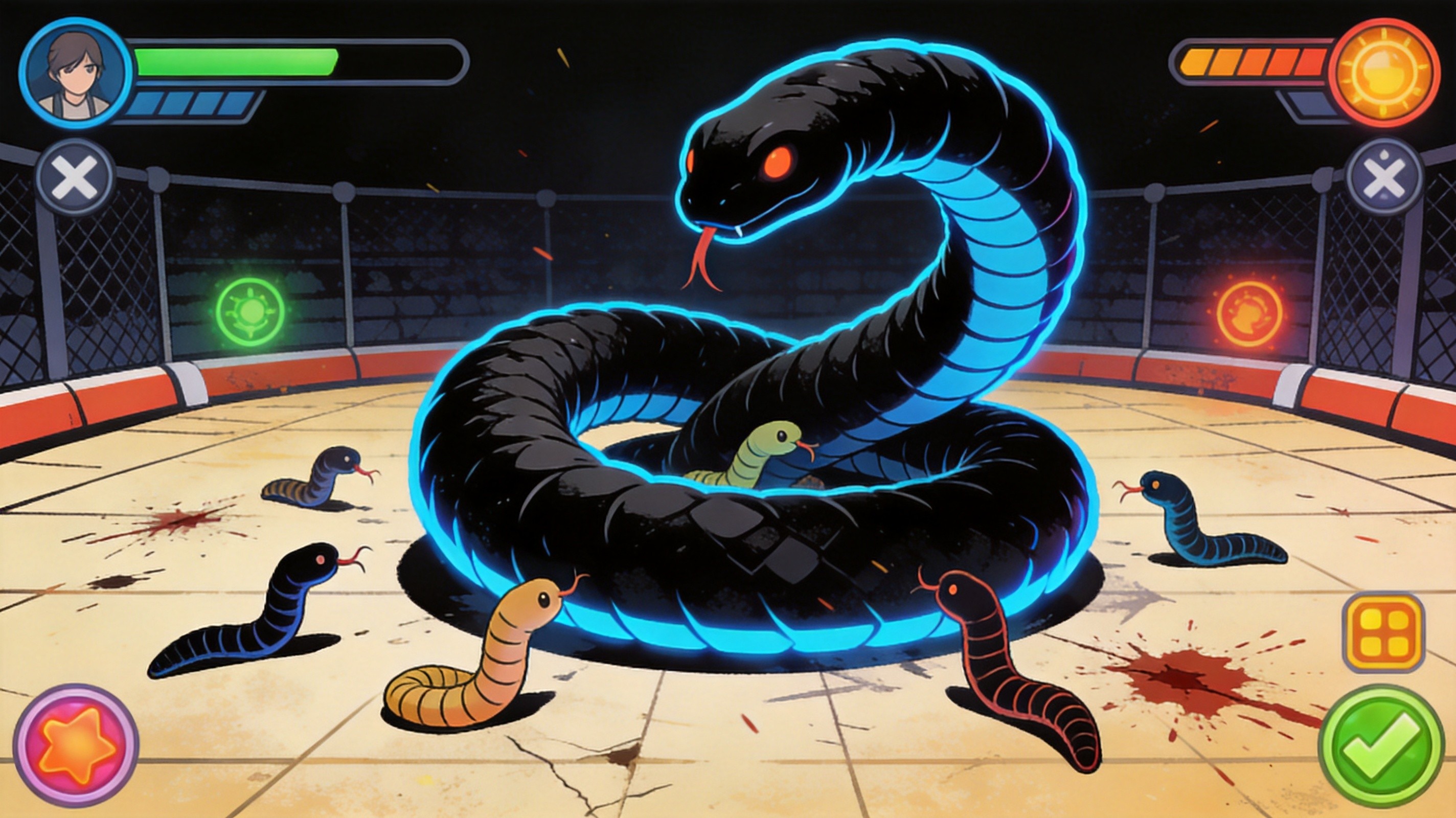
If you've played any snake io game, you've probably played Slither.io. It's the genre-definer — the game that spawned every worm-and-dot variant that followed. So how does Wormax.io actually stack up against Slither.io and the other major competitor, Wormate.io? I've spent significant time on all three, and they're more different than they appear.
Slither.io is the purest expression of the formula. You're a snake. You eat. You boost (at the cost of mass). You die if your head touches anything. That's it. No skills, no power-ups, no progression system, no artifacts. The appeal is simplicity — anyone can understand Slither.io in five seconds. The player base is enormous, which means full servers and constant action. But the skill ceiling is comparatively low. Once you've mastered boosting, circling, and cut-offs, there's not much more to learn. You're playing the same game at minute one and minute one thousand.
Wormate.io, developed by Oleksandr Godoba, takes the Slither.io formula and adds personality. The visual style is bright and candy-themed — your worm eats sweets, cakes, and donuts instead of generic dots. It has a robust power-up system: magnets that attract food, multipliers that double or triple food value, speed boosts, zoom-out vision, and shields. These power-ups spawn on the map and create moments of strategic decision-making. Do you detour for a magnet, or stay on your current food path? Wormate.io is the most visually appealing of the three and the most accessible for casual play. But its power-ups are random — you find them or you don't. There's less deliberate skill expression than in Wormax.io.
Wormax.io sits in a different spot entirely. The active skill system — boost, stop, ghost — means you always have tools available, not just when you stumble across a power-up. The progression system with leagues, essence, and artifacts gives you long-term goals beyond individual matches. The visual style is darker and more atmospheric than Wormate.io's candy-coated palette, which some players prefer and others find gloomy. Server populations tend to be smaller than Slither.io's, which means fewer worms per match but more room to maneuver and more meaningful individual encounters.
My verdict? Slither.io is the best entry point. If you've never played a snake io game, start there — the simplicity will teach you fundamentals fast. Wormate.io is the best casual experience — it's colorful, forgiving, and the power-ups add fun without complexity. Wormax.io is the best competitive experience — the skill system creates genuine depth, and the progression system rewards sustained play. If you're the type of player who wants to get better at something over time, not just kill an hour, Wormax.io is the pick.
There's also Wormax.io 2, which Elyland released with improved graphics and additional features. It's worth checking out if you enjoy the original, though the core community still primarily plays the original version. The sequel hasn't fully replaced it yet.
Artifacts, Essence, and the League Climb
One thing that genuinely surprised me about Wormax.io is how much the meta-progression matters. In most io games, your progress resets every time you die. Wormax.io has that — your in-match mass is gone when you die — but it also tracks your account rating across sessions. Play well consistently, and you earn essence. Essence lets you buy artifacts from the shop, which provide permanent upgrades to your worm.
The league system is structured as tiers. You climb by accumulating rating points from strong performances — not just getting big, but maintaining a high average mass, surviving long, and securing kills. Each league promotion feels meaningful because the competition gets noticeably harder. Players in the upper leagues use skills with a precision that's almost surgical. Ghost timings are tighter. Stop baits are more frequent and better executed. Boost usage is more economical.
Artifacts are where the long-term strategy lives. Different artifacts provide different bonuses — some enhance your skills, others improve your food intake or survivability. Choosing which artifacts to invest in is a meaningful decision that shapes your playstyle. I tend to favor artifacts that reduce skill cooldowns, because more ghost activations per match means more kill opportunities. But I've seen top players who swear by food-intake artifacts, arguing that faster growth gets you to the 500-point ghost threshold quicker, which compounds throughout the match.
The shop also offers cosmetic skins, which don't affect gameplay but do affect how other players perceive you. A worm with a rare skin signals experience, and that psychological edge can make opponents play more cautiously around you. It's subtle, but in a game where confidence determines aggression, every bit of intimidation helps.
Pro Insight: Don't spread your essence across multiple artifacts early on. Pick one that matches your playstyle and max it out first. A fully upgraded artifact is significantly more impactful than three partially upgraded ones. I made this mistake — I tried to upgrade everything equally and ended up with a bunch of mediocre bonuses instead of one strong one. Focus, then diversify.
Voices from the Server: Community Wisdom
I've spent a lot of time in the Wormax.io community — the Discord server, Reddit threads, YouTube comment sections. Here's what the player base is talking about, in their words.
A player who goes by SlitherSlayer on Discord told me: "The stop skill changed everything for me. I was stuck in mid-league for weeks because I kept dying in chases. Once I started using stop as a bait instead of running, my survival time jumped by like 40%. People just don't expect you to not move."
Another regular, GhostWalker_99, had this to say about ghost timing: "The mistake everyone makes with ghost is using it too early. You pop ghost the second you see trouble, and then you're visible again right when the trouble catches up. Wait until they're committed — until they've boosted toward you and can't change direction. Then ghost. They fly right past you and usually crash into something else."
On the competitive side, a player called NightCrawler shared their approach to the early game: "First 500 points are the hardest. You're small, you have no skills except boost, and everything can kill you. My strategy is to stay at the map edges and eat quietly until I hit 500. The moment ghost unlocks, I move to the center. Having ghost available completely changes how aggressive you can be."
The community also has strong opinions about Wormax.io 2. Most players I talked to appreciate the visual upgrades but feel the core gameplay hasn't changed enough to justify switching. "It looks better, but I already have hundreds of hours in the original," one Reddit commenter wrote. "The skill system is the same. Why start over?" Fair point.
There's also a healthy content creation scene. YouTube has Wormax.io gameplay compilations, skill tutorials, and full-match commentary. Watching skilled players is genuinely educational — you pick up positioning habits and timing patterns that text guides can't fully convey. I'd specifically recommend watching ghost-walk compilations. Seeing how top players use their five seconds of invisibility will reshape how you think about the skill.
Final Words from the Arena Floor
Wormax.io doesn't get the attention that Slither.io gets. It probably never will — Slither.io was first, it was a cultural moment, and it has the inertia of a massive player base. But if you're willing to look past the "just another snake game" surface, Wormax.io offers something its bigger competitor doesn't: a skill system that creates real strategic depth, a progression system that rewards sustained play, and a community that's small enough to feel personal but large enough to keep the servers populated.
If you're new, here's my roadmap. Spend your first few sessions learning the feel of the controls and getting comfortable with boost. Don't worry about stop or ghost yet — just survive, eat, and grow. Once you can consistently hit 1,000 points, start experimenting with stop as a baiting tool. Once you can consistently hit 500 points early in a match, start thinking about ghost timing. The skills build on each other. Learn them in order.
And don't get discouraged when you die. You will die. A lot. Everyone does. The worm that killed you will die too, probably within the next two minutes. That's the nature of io games — the arena is cyclical, and every death is a learning opportunity if you're paying attention. What killed you? Did you boost into a trap? Did you miss a minimap check? Did you waste ghost too early? Figure it out, respawn, and do better.
The leaderboard will come. The league promotions will come. The artifacts will come. But none of that matters if you're not enjoying the process. Wormax.io at its best is a flow-state game — that moment when you're weaving between three giant worms, ghost is about to expire, and you're threading a gap that shouldn't be possible. Chase that feeling. Everything else follows.
I'll see you on the server.