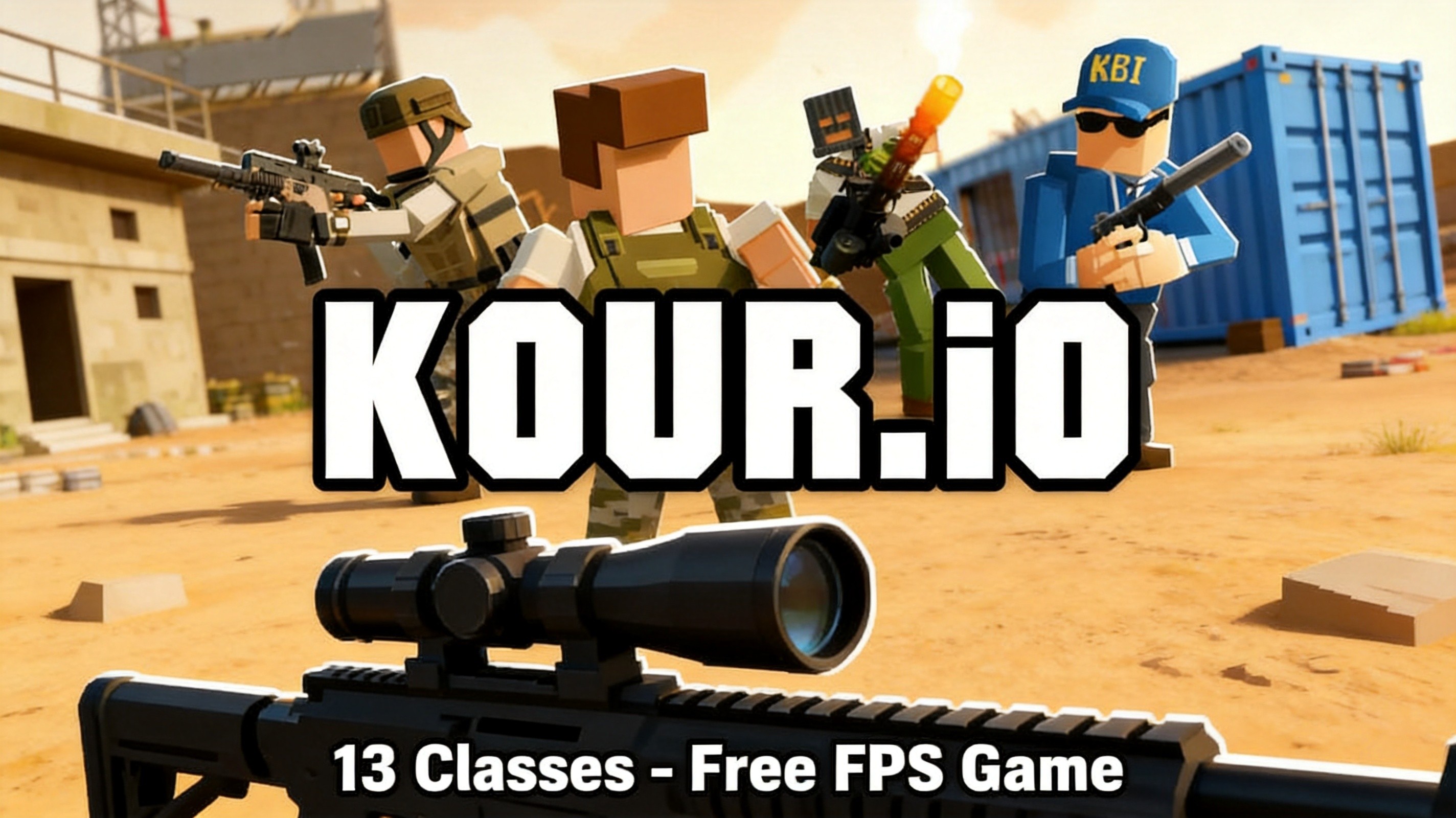
The Browser Shooter That Punches Above Its Weight
Here's what I expected when I first loaded kour.io: another janky browser FPS with floaty gunplay, maybe a deathmatch mode or two, and nothing to keep me around past the ten-minute mark. I was wrong about almost everything.
Kour.io is a class-based first-person shooter built by LEGiON Platforms that fuses traditional gunplay with a parkour movement system. You wall-run across vertical surfaces, bunny hop to preserve momentum, dash through doorways, and slide under obstacles — all while shooting at people who are doing the same thing. It launched in March 2024 as a free browser game, no download, no account required, and it runs on everything from a gaming desktop to a school Chromebook. That accessibility is a big part of why it has grown the way it has.
What surprised me most wasn't the polish (though there's more of it than you'd expect). It was the depth. Thirteen classes, each with a unique weapon and HP pool. Seven official game modes, plus a handful of community-created ones. Five maps with genuinely different tactical identities. A progression system built around Kour Points (KP) that unlocks cosmetics, crates, and emotes. Clans. Leaderboards — daily, monthly, and all-time. A map editor. For something that loads in your browser tab, the scope is borderline ridiculous.
Editor's Note: I came to Kour.io after sinking weeks into Krunker.io and Kirka.io. Both are solid browser shooters, but neither gave me the same feeling of mechanical expression that Kour.io does. The movement system here isn't decorative — it's load-bearing. When you chain a wall-run into a bunny hop into a dash through a window and land a headshot mid-air, it feels earned. That's rare in a free browser game, and it's why I kept playing long after I planned to stop.
The developer has stayed active, too. New maps like Kour House have shipped since launch, community modes like KourCraft (a Minecraft-inspired build-and-fight variant) have been embraced rather than shut down, and the class roster has expanded beyond the original nine. This is a game that's still growing. My guide reflects where Kour.io stands right now, in mid-2026, after the most recent updates.
Speaking the Movement Language
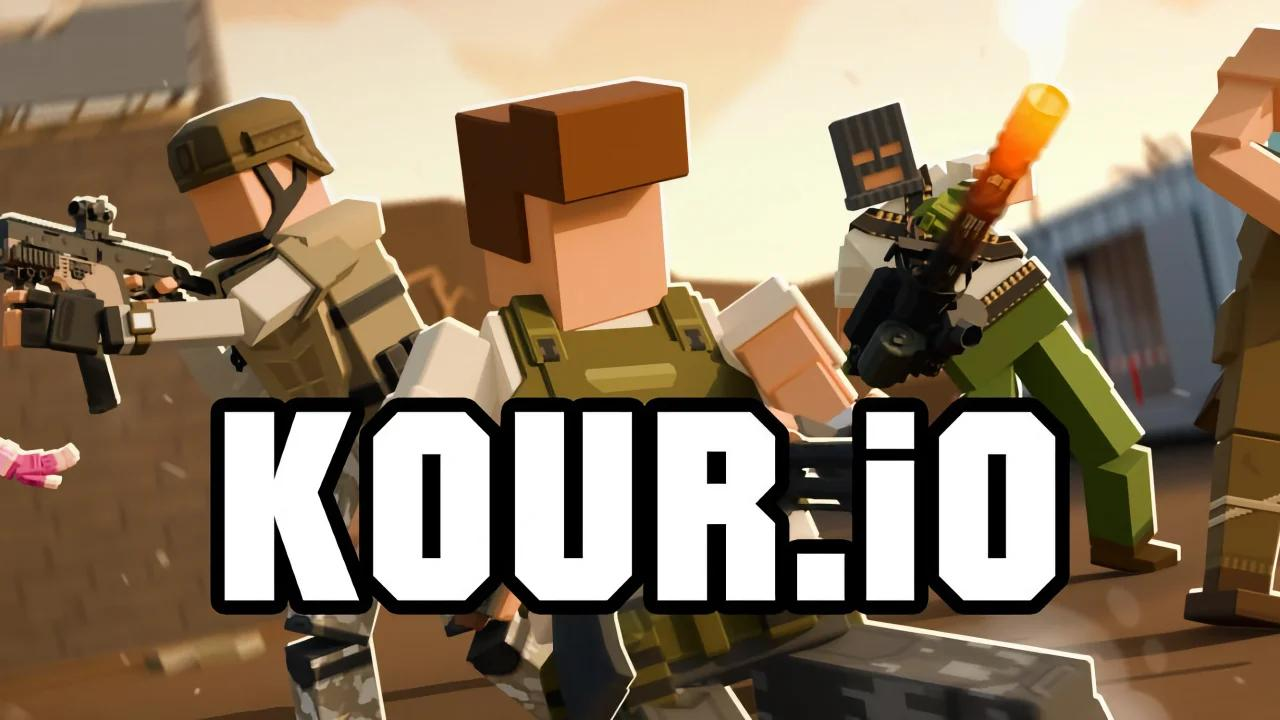
If you've played any Source-engine shooter — Counter-Strike, Team Fortress 2, any of the_surf maps — the movement in Kour.io will feel familiar in concept but different in execution. The game has its own physics, its own quirks, and its own skill ceiling, and learning to speak its movement language is the single biggest thing you can do to improve.
Let me break down the four core techniques.
Bunny hopping (B-hop). This is the big one. Press W + Space to start your jump, then immediately release W. While airborne, use only A and D to steer, and move your mouse smoothly in the direction you're strafing. Never touch W during a hop — it kills your momentum. Chain consecutive hops and you'll build speed that makes you nearly impossible to track. I spent my first two days getting this wrong; I kept holding W out of habit and wondering why I was slower than everyone else. Once it clicked, the game opened up completely.
Wall-running. Sprint-jump into any vertical surface and you'll stick to it, running horizontally along the wall. This resets your double-jump and gives you a bullet-dodge option. Wall-runs also reload your weapon 50% faster — yes, you read that right. Reloading mid-wall-run is faster than reloading on the ground. This is the kind of mechanic that sounds like a bug until you realize it's a deliberate design choice that rewards aggressive movement.
Dashing. Hit E and you'll dash in your movement direction. It's a burst of speed with a cooldown, useful for dodging sniper fire, closing distance, or escaping a bad fight. The dash is your emergency button — don't waste it on open ground when there's no threat.
Sliding. Shift or C while moving sends you into a slide. You can slide under obstacles, cancel into a wall-run from a slide, and use the slide itself to maintain momentum between hops. It's the connective tissue between your other movement options.
Here's the thing that took me an embarrassing number of matches to internalize: these techniques are not independent. They're a vocabulary. A wall-run that ends with a double-jump into another wall maintains 20% extra speed, stackable up to three times. A slide can cancel into a wall-run. A dash can extend a bunny-hop chain. The players who dominate Kour.io aren't the ones with the best aim — they're the ones who never stop moving.
Pro Insight: Turn on developer options in settings to see your speed in real time. Watching that number go up when you chain techniques correctly is the fastest way to build muscle memory. I practice movement for five minutes in ParKour mode before every competitive session — it's the equivalent of a guitarist running scales.
Thirteen Weapons, Thirteen Attitudes
Kour.io's class system isn't just "pick a gun." Each class is a philosophy of combat. The weapon dictates how you move, where you position, and which fights you take. Let me walk through them the way I think about them — by what they ask of you as a player.
The reliable ones. Soldier (AK-47, 100 HP) is your baseline. Balanced, effective at most ranges, forgiving of imperfect aim. If you're new, start here. Agent (Silenced MP5, 100 HP) trades the AK's range for stealth — enemies don't get a direction indicator when you shoot, which makes the Agent a flanker's dream. Assassin (FAMAS, 100 HP) fires in bursts, rewarding trigger discipline and headshot placement. All three sit at 100 HP, so they're not glass cannons — you can take a hit and survive.
The specialists. Hitman (Sniper, 90 HP) is pure long-range. One shot, one kill if you hit the head. On Havana's open sightlines, a good Hitman controls the match. In Kour House's tight corridors, they're a liability. Gunner (P90, 90 HP) is the inverse — close-range spray that shreds in CQB but falls off past mid-range. Rocketeer (Rocket Launcher, 90 HP) trades precision for area denial; you don't need to hit directly, just near enough. And Brawler (Shotgun, 120 HP) is the aggressive pusher — 120 HP means you can trade body shots and still come out ahead in a hallway fight.
The tank. Heavy (Machine Gun, 150 HP) is the role player. Nearly double the HP of most classes, a weapon that suppresses without needing precision, and a reload that takes long enough to punish poor positioning. The Heavy isn't flashy. But in Hardpoint, a Heavy planted on the objective with teammates feeding him information is genuinely difficult to dislodge.
The unlockables. Hit 10 kills in a session and four more classes open up. Juggernaut (Minigun, 130 HP) is the Heavy's louder cousin — more fire rate, less control, pure suppression. Recon (Vector, 80 HP) is the fastest class in the game, built for information gathering and hit-and-run engagements. Pyro (Flamethrower, 110 HP) dominates tight spaces; on Kour House, a Pyro holding a corridor is a wall of fire that nobody wants to walk through. And Rayblader (Laser Gun, 95 HP) has a damage profile unlike anything else in the game — it's the wildcard, the experimental pick, the class that makes people in the lobby go "wait, what does that thing do?"
Then there's the Investor (Scar Rifle, 90 HP). I'll be honest — I'm still figuring this one out. The community consensus is that it's a utility pick, somewhere between the Soldier and the Assassin. It hits hard, but the semi-auto fire rate means you need to make every shot count. I've seen players do terrifying things with it, but I haven't found my groove with it yet.
My recommendation? Learn two classes, not one. Pick a generalist (Soldier or Agent) for when the match is chaotic and you need adaptability. Then pick a specialist (Hitman or Brawler) for when the map and mode favor them. Switching between two complementary classes teaches you more than grinding one ever will.
Editor's Note: The 10-kill unlock threshold resets per session, not permanently. When you log out and back in, you start fresh. This is actually good design — it means new players aren't permanently locked out of the fun classes, but it also means you can't coast on unlocks you earned yesterday. It rewards showing up and playing well from the first match.
Five Arenas, Five Different Games
A map in Kour.io isn't just a different skin over the same gameplay. Each one changes which classes work, which movement techniques matter, and what the optimal strategy looks like. I want to walk you through all five because understanding the maps is where the gap between decent players and good players lives.
Havana. The first map, based on a Cuban city, and still the most competitive. It's tropical, bright, and offers a mix of open sightlines and tight alleyways. This is the map where the Hitman shines — long streets give snipers clear lanes to control. But the rooftops are accessible via wall-runs, which means a Brawler who knows the vertical routes can flank a sniper from above. Havana rewards players who think in three dimensions.
Ghost Town. Inspired by Nuke Town from Call of Duty, this abandoned Arizona desert town is all about rooftop warfare. The buildings are close together, which means wall-run chains are viable almost everywhere. Shotguns and SMGs excel here because engagements are close and fast. The Hitman is weaker on Ghost Town — too many angles, not enough long sightlines. If I had to pick one map to practice movement on, it'd be this one.
Snowstorm. Set in Iceland with freezing ocean views and purple skies, this winter map is the most visually striking of the five. The snow reduces visual contrast, which can make spotting enemies harder at first. Open central areas favor mid-range weapons like the AK-47, while the buildings along the perimeter create CQB pockets. It's a balanced map — no single class dominates.
Kour House. The newest map, and my personal favorite. Boost pads, shipping containers, and multi-level buildings create a layout that's built for momentum. The boost pads in particular change everything — they launch you across gaps that would otherwise require careful wall-run chains. Pyro and Brawler are devastating here because the corridors are tight and the sightlines are short. If you want to practice using green laser zones and boost pads, Kour House is the map for it.
Legion HQ. Modeled after the LEGiON Platforms headquarters, this office complex is the most tactical map in the game. Long hallways, glass walls, and cubicle mazes create a CS:GO-like feel where positioning and crossfire setups matter more than raw movement. The Heavy and Juggernaut shine here — hold an angle with 150 HP and a machine gun and you become a door that enemies have to break through. Trick shots are a thing on this map; I've seen players wall-run across the atrium and land mid-air flick shots that made my jaw drop.
The Mode Spread: Where Kour.io Gets Weird
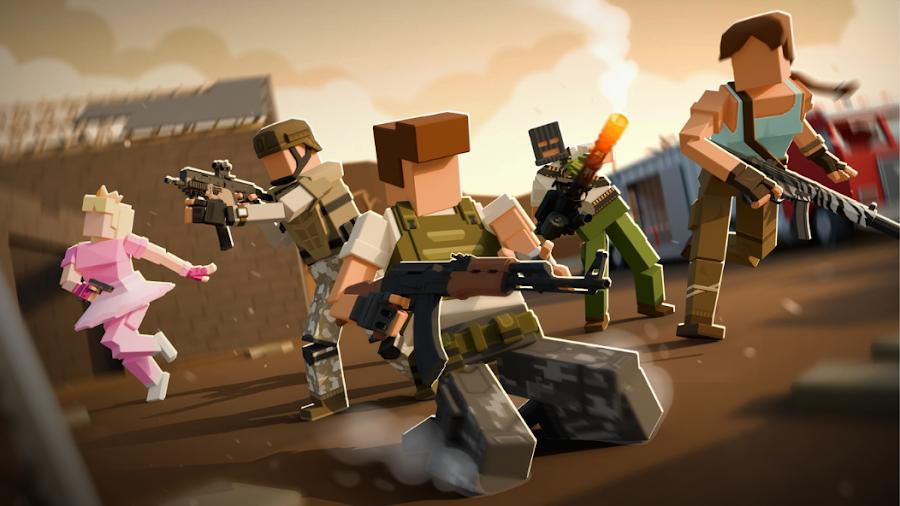
Seven official modes is a lot for a browser game. Some of them are standard FPS fare. Others are genuinely strange in a way that I appreciate. Let me sort them by how much they'll surprise you.
Free For All is what it sounds like — everyone against everyone, most kills wins. This is where you go to practice raw mechanics. No team to carry you, no objectives to hide behind. If your aim and movement are bad, FFA will tell you immediately.
Team Deathmatch is the same but with teams. The dynamic shifts: coordinated teams can set up crossfires, trade kills effectively, and control map positions. On Legion HQ, a TDM match between two organized clans is a genuinely tactical experience. On Havana, it's a chaotic sprint through sniper lanes.
Gun Game cycles your weapon with every kill. You start with a knife and work through the entire arsenal. This is the mode that taught me which weapons I'm actually good with — turns out I can't hit anything with the Rocketeer's rocket launcher under pressure, but my FAMAS burst timing is decent. Gun Game is also the best training for adaptability, because you can't rely on one weapon's muscle memory.
Hardpoint is the tactical mode. Capture and hold rotating objective zones. Positioning, map control, and team coordination beat raw aim here. A Heavy sitting on the point with a Juggernaut covering the approach can hold for an embarrassing amount of time. This is also where green laser zones matter most — rotating between Hardpoint locations faster than the enemy team is how you win.
Then we get to the weird ones.
ParKour is where Kour.io earns its name. Shooting meets obstacle course racing. You navigate complex jumps and wall-run sequences while other players are trying to shoot you. It's part platformer, part deathmatch, and it's the best movement training in the game. I cannot overstate this — if you're struggling with movement mechanics, spend 30 minutes in ParKour mode and you will improve faster than you would in any other mode. It's also genuinely fun in a way that pure deathmatch isn't.
MoonSnipe takes place on the moon with reduced gravity. Everyone gets a sniper. You jump higher, float longer, and pick off enemies from angles that don't exist in normal gravity. It's slow, deliberate, and completely different from every other mode. Some players hate it. I think it's brilliant — it forces you to think about positioning and timing instead of twitch reflexes.
KourSurf is the strangest. Surfing mechanics borrowed from the Source-engine surf map tradition, combined with combat. You slide along angled surfaces, build momentum, and shoot people while moving at speeds that make the rest of the game feel sluggish. It's chaotic, skill-intensive, and has a dedicated player base that plays almost nothing else. If you've never surfed in a Source game, KourSurf will feel alien. Give it an hour before you judge it.
Beyond the official seven, the community has created modes like KourCraft (build structures and fight, Minecraft-style), FFA 35 (a 35-minute free-for-all marathon), and even a battle royale variant called Kourzone. The map editor means these community modes have custom arenas built for them, and the server browser lets you find lobbies running whatever you're in the mood for.
Stacking Speed: The Momentum Economy
Here's where I want to get into the weeds, because this is the stuff that separates a player who wins fights from a player who wins matches.
Kour.io runs on a momentum economy. Speed is currency. The faster you move, the harder you are to hit, the faster you rotate between objectives, and the more options you have in any given engagement. Every map has tools for generating speed, and the players who use them intentionally rather than accidentally are the ones who climb the leaderboards.
Green laser zones appear on most maps as glowing green pads on the ground. Walking through one grants a temporary speed boost. On Kour House, they're placed near boost pads, which means a player who knows the route can chain a green zone into a boost pad launch into a wall-run and cross the entire map in under three seconds. On Havana, the green zones are near the central chokepoints — running through one mid-fight gives you a half-second of acceleration that can be the difference between dodging a sniper shot and eating it.
Boost pads are the more dramatic version. Step on one and you're launched — across gaps, up to rooftops, over enemy sightlines. They're Kour House's signature feature, and the map is built around them. Learning the boost pad routes on Kour House is like learning a speedrun — once you know the sequence, you can traverse the map faster than anyone chasing you can follow.
Chained momentum is the advanced technique. After a wall-run ends, immediately double-jump and land on another wall to maintain 20% extra speed. This stacks up to three times. Three chained wall-runs with proper bunny hopping between them gives you a speed that makes you essentially untouchable in a straight fight — not because you're dodging, but because the enemy can't track you fast enough.
Slide-to-wall-cancel is a niche but powerful technique. Slide under a window or low opening, then pop up into a wall-run on the other side. It's a movement sequence that catches campers completely off guard — they hear you slide, assume you're going low, and then you're suddenly running along the wall above their head.
Let me give you a concrete scenario. Last week I was playing Hardpoint on Kour House, defending a point in the shipping container area. An enemy Heavy was holding the corridor with a machine gun, 150 HP, dug in. I came in as Agent — 100 HP, silenced MP5. A direct push would have been suicide. Instead, I hit the green zone outside the container, chained into a boost pad that launched me onto the container's roof, wall-ran along the container wall to flank behind him, and dropped down with a melee kill before he could turn around. That sequence took maybe four seconds. It's the kind of play that makes Kour.io feel like no other browser shooter.
Pro Insight: Here's a mechanic that most players sleep on: reloading during a wall-run is 50% faster. If you need to reload mid-fight, don't stand behind cover like it's Counter-Strike. Sprint-jump into the nearest wall, reload while you're running horizontally, and come out the other side with a full mag and a positional advantage. I started doing this deliberately about a month ago and my survival rate in extended fights went up noticeably.
One more thing on settings: enable developer options to see your speed in real time. Set your FPS cap as high as your machine will allow — Kour.io's movement system is frame-dependent at the margins, and higher framerates reduce input lag on dashes and jumps. If you're on a Chromebook and struggling with performance, try disabling textures in the settings. It looks ugly, but it plays better.
Standing in the Crowd: Kour.io vs Krunker, Kirka, and Deadshot
If you've spent any time in the browser FPS scene, you've probably played at least two of these games. They're all free, they all run in a browser, and they all have their own approach to movement and gunplay. I've spent serious time on each, and I think the comparisons are worth making because they highlight what Kour.io does differently.
Krunker.io is the elephant in the room. It's been the dominant browser FPS for years, has a massive player base, and its movement system — slide-hopping, bunny hopping — is the gold standard that other browser shooters are measured against. Krunker's gunplay is tight and the class system is well-balanced. Where Kour.io differentiates itself is the parkour layer. Krunker has movement tech, but it's horizontal. Kour.io adds vertical movement — wall-runs, wall-jumps, vertical boost chains — that creates a genuinely three-dimensional combat space. If Krunker is a flat-plane shooter with fast movement, Kour.io is a full 3D arena where the walls and ceilings are part of your toolkit.
Kirka.io takes the voxel aesthetic (think Minecraft graphics) and applies it to a class-based FPS. It has wall-climbing, which is Kour.io's wall-running's quieter cousin. Kirka's gunplay is solid, and the voxel style gives it a distinctive look. But Kirka's movement is more limited — there's no bunny hopping, no surfing, no momentum chaining. Kour.io is the more expressive game mechanically, while Kirka is the more approachable one. If you want something simpler to pick up, Kirka is great. If you want a higher skill ceiling, Kour.io wins.
Deadshot.io is the movement specialist of the group. Its slide-jumping system is satisfying and its gun feel is excellent — the weapons have weight and recoil patterns that reward practiced aim. Deadshot is probably the closest competitor to Kour.io in terms of movement depth, but the two games take different approaches. Deadshot focuses on a smaller set of movement techniques executed with precision. Kour.io throws more options at you — wall-runs, dashes, slides, boost pads, surfing — and asks you to combine them. Deadshot is a scalpel; Kour.io is a Swiss Army knife.
My honest take? They're all worth playing. If I had to pick one, I'd go with Kour.io for the variety — the class system, the mode diversity, and the movement depth give it the most replay value. But Krunker's community is larger, Kirka is more beginner-friendly, and Deadshot has the tightest gunplay. The best browser FPS is the one you actually keep playing, and I keep coming back to Kour.io.
The KP Grind and the Clan Question
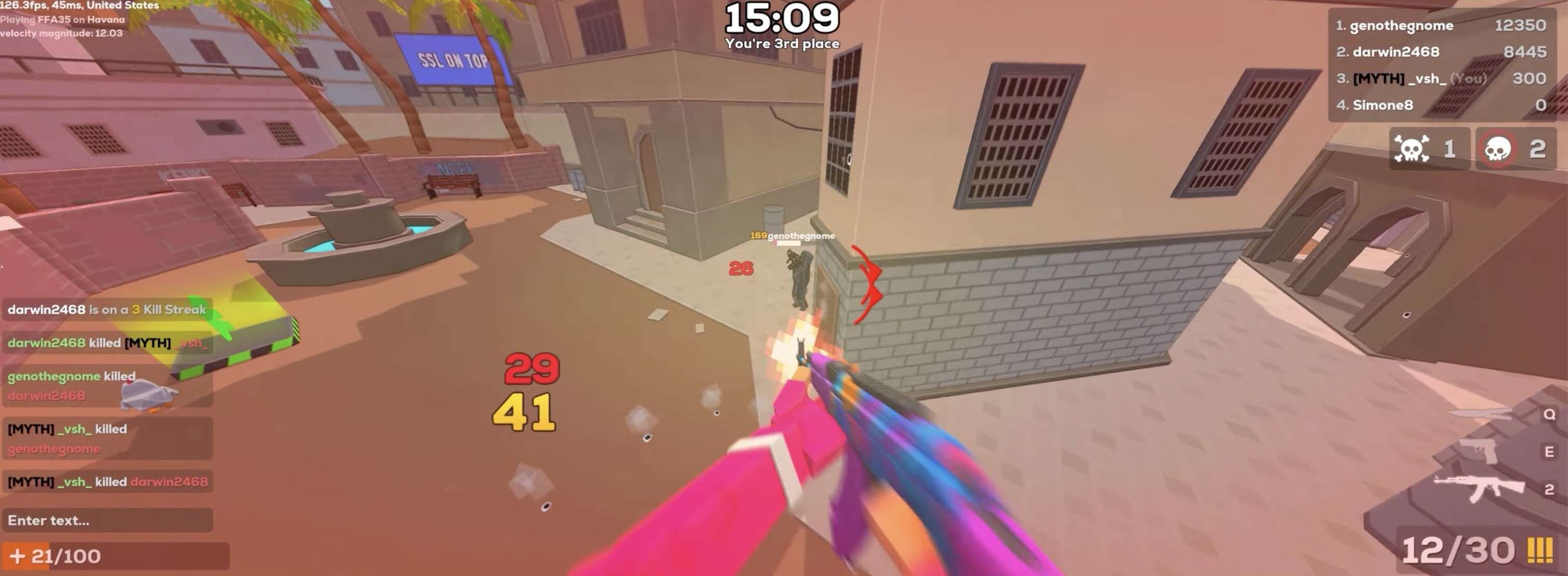
Kour.io's progression is built on Kour Points (KP). You earn them through kills, completing missions, and winning matches. You spend them on skins, crates, hats, emotes, and characters. It's a cosmetic-only economy — no pay-to-win, no gameplay advantages locked behind a paywall. Everything that affects gameplay is available to everyone from the start.
Missions are where the real KP comes from. They give you specific objectives — win matches with certain classes, get headshots, complete ParKour courses — and the payouts are significantly better than random kills. A player who grinds missions will unlock cosmetics twice as fast as one who just plays FFA for hours. My advice: check your mission list before you start a session and pick classes and modes that align with your active objectives. It's a small thing that compounds over weeks.
You can also earn free KP by watching ads. It's not glamorous, but if you're a student or just don't want to spend money on browser game cosmetics, it's a legitimate path. The free crate from ad-watching is a nice touch — it's a gamble, but occasionally you get something good.
Clans are where Kour.io's social layer lives. You can create or join a clan, and clan membership matters most in TDM and Hardpoint, where coordinated teams dramatically outperform groups of randoms. The difference between a team of five randoms and a clan squad with callouts is night and day — it's not even close. If you're playing Hardpoint seriously, find a clan. The Discord has a clan recruitment channel; that's where I found mine.
Leaderboards track daily, monthly, and all-time rankings. The daily board resets every 24 hours, which means it's actually achievable for active players to hit the top. The all-time board is where the veterans live — the names there have been grinding since launch. Checking the leaderboard before a session gives you a target. "I'm ranked 340 today. Let me get to 300." Small goals keep the grind interesting.
The map editor deserves a mention here, too. It lets players create custom arenas, and the community has run with it — maps range from faithful recreations of CS:GO layouts to absurdist obstacle courses that exist purely to test movement skills. The server browser lets you find lobbies running custom maps, and some of the best movement practice I've had was on a community-made surf map that a player built specifically for b-hop training.
Editor's Note: Don't fall into the cosmetic trap. KP unlocks skins and emotes that look cool, but they don't make you play better. I've watched players dump hours into farming KP for a specific skin and neglect their actual skills. Set a cosmetic goal, work toward it through missions, and spend the rest of your time practicing movement and learning matchups. The skins will come. The skills won't, unless you put in the work.
Where the Players Actually Are
A game is only as good as its community, and Kour.io's community is one of its strongest assets. The Discord server is active, the player base is large enough that you can find a match at any hour, and — this is important for a competitive FPS — the toxicity is manageable. I've encountered the occasional trash-talker, but nothing close to what you'd find in a ranked CS:GO match or a League of Legends game. People are generally willing to help, answer questions, and share techniques.
Clan battles are the closest thing Kour.io has to an organized competitive scene. Two clans schedule a match, pick their best lineups, and play a series across multiple modes. The results usually get posted in the Discord, complete with highlight clips and post-match analysis. It's not an official tournament circuit, but it has that energy — organized, competitive, and genuinely fun to follow.
YouTube is where the technique-sharing happens. Search "Kour.io movement guide" and you'll find tutorials from top players breaking down b-hop chains, wall-run routes, and class-specific strategies. I learned more about ParKour mode from a single ten-minute YouTube video than I did from my first week of solo practice. Watch the people who are better than you — it's the fastest shortcut to improvement.
The developer presence matters here, too. LEGiON Platforms is active in the community, takes feedback, and ships updates. New maps have been added since launch, balance tweaks happen, and the community-created modes weren't just tolerated — they were given server browser support and map editor tools. This is a game that's being actively maintained, not abandoned. That matters for longevity.
One thing I'd love to see: an official ranked mode with a ladder system. The current leaderboards are kill-count-based, which rewards volume over skill. A proper ELO-style ranked system would give competitive players something to grind toward and would make matchmaking more meaningful. It's the most common request I've seen in the Discord, and I think the player base is large enough to support it now.
What I'd Tell Myself on Day One
If I could go back to my first session, here's what I'd say: stop holding W. Learn to bunny hop before you learn to aim. The movement is the game — everything else is built on top of it.
Here's the short version of everything I've learned in the weeks I've been playing Kour.io:
Start with Soldier. It's the most forgiving class, effective at most ranges, and it won't punish you for mechanical mistakes. But don't stay with Soldier forever — once you're comfortable with movement, pick up the Hitman or the Brawler and learn what it feels like to specialize.
Practice in ParKour mode. Not FFA. ParKour. It's the movement tutorial that the game doesn't explicitly label as one, and it's where your b-hop chains, wall-runs, and dash timings will actually develop. Twenty minutes in ParKour before a competitive session will do more for your win rate than an hour of deathmatch.
Learn the green zone and boost pad locations on every map. Not approximately — exactly. The difference between knowing "there's a green zone somewhere near the center" and knowing "the green zone is behind the blue container, three steps left of the doorway" is the difference between using them intentionally and stumbling into them by accident.
Reload on walls, not behind cover. This took me too long to internalize. The 50% reload speed bonus during wall-runs is not a niche mechanic — it's a core survival technique. Every time you need to reload in a fight, your instinct should be to find a wall, not a corner.
Push for 10 kills early. The four unlockable classes add real tactical variety, and you want them available for the back half of your session. Play aggressive in your first few matches, rack up those kills, and then settle into your preferred playstyle with the full roster available.
And finally — and I know this sounds corny — have fun with it. Kour.io is at its best when you're not thinking about your K/D ratio or your leaderboard position. It's at its best when you wall-run off a building, dash mid-air to dodge a rocket, land behind a Heavy who thought he was safe, and melee him in the back of the head before he can turn around. Those moments don't show up in your stats. They're the reason you play.
Ready to wall-run? Head to kour.io and start climbing the leaderboards.
Play Kour.io NowLast updated: July 30, 2026
Written by iogameguide Editorial Team - Alex Rivera