I've spent more hours in Agar.io than I care to admit. What started as a lunch-break distraction in 2015 turned into something closer to an obsession — the kind where you catch yourself thinking about split trajectories while you're supposed to be doing other things. This guide isn't for someone who just discovered the game. If you're still learning that Spacebar splits your cell and W ejects mass, head over to our Agar.io Beginner's Guide first. Come back when you're ready to stop surviving and start running the server.
What follows is everything I've learned from thousands of matches, hundreds of conversations with top-tier players, and more failed pop splits than I can count. I'm going to skip the obvious stuff and get straight into the mechanics that actually matter at a high level.
🧪 The Physics of Consumption: Why Mass Is Everything
Every single decision in Agar.io comes down to one relationship: mass determines size, and size determines speed. The bigger you are, the slower you move. That's it. That's the entire game compressed into a single sentence. But the implications of that relationship are enormous, and most players never fully internalize what it means.
Let me put some numbers on it. A cell at 50 mass moves roughly twice as fast as a cell at 500 mass, and a cell at 2,000 mass crawls like molasses. When you're small, you can juke, dodge, and weave through tight spaces that a larger cell physically cannot fit through. When you're massive, you can barely catch anything that doesn't want to be caught — unless you split, which creates its own problems.
Mass also decays. Once you cross roughly 150 mass, you start losing mass passively over time. The bigger you get, the faster you bleed. A cell at 10,000 mass loses mass at an alarming rate just by existing. This means standing still is never truly safe at large sizes — you're always on a timer, always needing to consume faster than you evaporate. I've watched players hit the top of the leaderboard and then slowly shrink over two minutes because they got comfortable and stopped hunting.
Here's the part that trips people up: you can only eat a cell that's at least 10% smaller than you. Not "roughly the same size" — measurably, mathematically smaller. And when you split, each piece is half your mass. So if you're at 400 mass and you split, each piece is roughly 200. That 200-mass piece can eat a cell up to about 180 mass. The math matters. You need to know your numbers before you commit to a split, because a miscalculation means you've just halved your size for nothing.
Editor's Note: I spent my first month playing Agar.io without understanding the mass decay mechanic. I'd hit 3,000 mass, feel invincible, and then watch myself slowly shrink while wondering what was happening. Once I understood that large mass bleeds away, my entire approach changed. Now I treat the leaderboard as a temporary position, not a permanent one — and I play accordingly.
✂️ Blade Work: The Split as Weapon, Shield, and Speed Boost
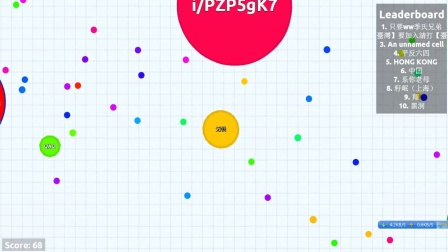
The split is the single most important mechanic in Agar.io. Press Spacebar and your cell divides in half — one piece stays put, the other launches forward at high speed in the direction of your cursor. You can split up to four times, creating a maximum of 16 pieces. Every split is a gamble: you gain offensive range and mobility, but you sacrifice concentrated mass and become vulnerable to anyone who can eat your scattered pieces.
I want to walk through the specific split techniques that actually matter in competitive play. Not the theoretical ones — the ones I've seen win and lose games.
The Pop Split
This is the technique that separates good players from great ones. Here's the setup: you're chasing a player who's near a virus (those green spiky things). You're significantly larger than them — say 4,000 mass to their 2,000. You split twice toward them. Your smallest piece hits them, they eat it, and in that instant they expand enough to touch the virus behind them. The virus pops them into fragments, and your next piece — which is still barreling forward — sweeps up all those fragments before they can scatter.
The timing is brutal. Split too early and you hit the virus yourself. Split too late and they've already gained momentum away from the virus. I'd estimate I hit maybe 60% of my pop splits on a good day, and the 40% I miss usually cost me mass. But when they connect? You can gain thousands of mass in a single second. It's the most satisfying play in the game.
There's a variation for smaller targets too. If the player is too small to eat your fourth piece normally, you split three times instead — first away from the target, then two splits toward them. This gives you a bigger piece for the pop. It's riskier because you're spending more time fragmented, but sometimes it's the only way the math works.
The Self-Feed Escape
When you're surrounded and a larger player is closing in, split away from them three or four times. Keep your pieces close together — you want them clustered, not spread out. Then rapidly press W to feed mass into your center piece. If you do it fast enough, that center piece grows large enough to eat the predator when they try to split on you. It's essentially a trap: you look small and fragmented, which invites aggression, but you're secretly funneling all your mass into one piece.
The downside? You lose a significant chunk of mass to the W-feed mechanic itself. Mass ejected with W isn't 100% efficient — some of it just disappears into the void. So this is a desperation move, not a strategy you build around. But it has saved my life more times than I can count.
The Chain Split
Chain splitting is for food collection, not combat. You split repeatedly — two, three, four times — creating a wide net of small cells that sweep through a pellet-dense area. Each piece grabs food independently, so you're effectively eating from 8 or 16 locations simultaneously. Once the pieces recombine, you've gained mass much faster than you would have crawling along as a single cell.
The risk is obvious: while you're split into 16 tiny pieces, you're prey for anyone medium-sized nearby. I only chain split when I've confirmed the area is clear of threats — usually by checking the minimap and visually scanning before committing. A chain split in a crowded zone is suicide.
The Linesplit
This one's mostly for entertainment, but it's worth knowing. If you place your cursor at the exact center of your cell and split four times without moving, your pieces form a horizontal line. It looks cool and covers a wide area, but a skilled player will eat your scattered pieces one by one. I've seen it used effectively as a bait — the linesplit looks like a mistake, which draws greedy players in — but it's high-risk and I wouldn't recommend it in serious play.
Pro Insight: The recombine timer is your most important clock. After splitting, your pieces take roughly 30 seconds to merge back together (the exact time depends on your total mass — larger cells take longer). During those 30 seconds, you're running a risk calculation with every passing moment. The longer you stay split, the more likely something goes wrong. I've developed a habit of mentally counting down after every split. When I hit 15 seconds, I start looking for safety. When I hit 25, I'm actively retreating to recombine. Treat the timer like a grenade pin.
🟢 Green Spikes and Dirty Tricks: The Virus Economy
Viruses are the most misunderstood mechanic in Agar.io. Most players treat them as obstacles — things to avoid when you're big, things to hide behind when you're small. That's like treating a loaded gun as a paperweight. Viruses are weapons, and the players who understand their full potential control the game.
Let's cover the basics fast. Viruses are green spiky circles scattered across the map. If a cell larger than a virus touches it, the cell explodes into up to 16 pieces. If you're small enough, you can hide inside a virus safely. And — here's the key — if you feed a virus with W seven times, it spawns a new virus that shoots in the direction you were feeding.
That last mechanic is where the real strategy lives.
Virus Shooting: The Long-Range Assassination
You see a massive player on the other side of the map. They're at 8,000 mass, lumbering around, eating everything in sight. You're at 1,200 mass. Normally, you'd run. But there's a virus between you and them.
You position yourself behind the virus, aim at the giant, and start feeding it with W. Seven presses later, a new virus launches across the map at high speed. If it hits the giant, they explode into 16 pieces — each one small enough for you and every other scavenger nearby to devour. I've personally taken down players five times my size this way. The look on their face — well, you can't see their face, but you can imagine it.
The counter to virus shooting is awareness. Experienced players watch for smaller cells camping behind viruses, and they'll either avoid the area or eat the virus-shooter before they can launch. It's a cat-and-mouse game that adds an entirely different layer to Agar.io's combat.
The Virus Farm
At 400+ mass, you can deliberately split into viruses for a mass boost. It sounds counterintuitive — why would you touch the thing that destroys you? — but here's the trick: if you're split into 16 pieces and your largest piece is big enough, each piece can consume a virus individually. Since viruses have mass (roughly 100-130 each), consuming them actually feeds you. You're converting the hazard into food.
This is an advanced technique that requires precise mass management. If any of your pieces is too small when it touches a virus, that piece pops instead of consuming. I'd recommend practicing this in a private server before trying it in FFA. The reward is significant — you can gain 1,000+ mass in seconds — but the failure mode is catastrophic.
Virus Walls
By feeding multiple viruses in a line, you can create a wall of green spikes that larger players can't cross without popping. This is especially useful in team modes, where you can build defensive perimeters around your team's territory. In FFA, it's more situational — you can use a virus wall to block a pursuing giant, giving yourself time to escape.
🦈 Food Chain Math: Predator Timing and Prey Survival
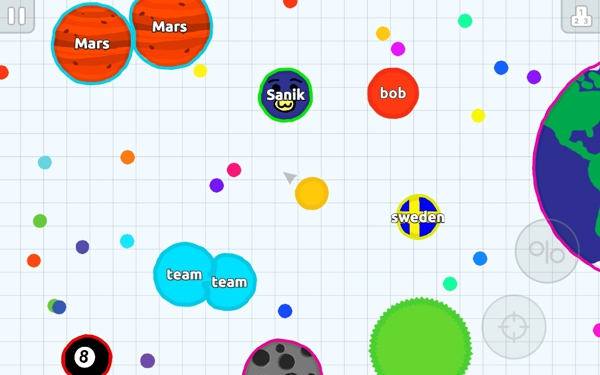
Agar.io is a food chain simulator. At any given moment, you're either predator or prey — sometimes both simultaneously, depending on who's around you. The best players I've watched don't think in terms of "I'm big" or "I'm small." They think in terms of relationships: who can eat whom, and how fast can that change?
Hunting as a Predator
The mistake I see most often from medium-sized players is chasing. Chasing is for amateurs. A good predator doesn't chase — they predict. You watch the prey's movement pattern, identify where they're heading, and position yourself between them and their destination. Then you split. If you've read the geometry correctly, they run directly into your launched piece.
Cornering is the most reliable kill method. Drive a smaller cell toward a map boundary or corner. Once they're against the wall, their escape angles shrink to zero. A single split covers the remaining distance. This works at any size differential where you can legally eat them.
One community member I spoke with — a player who goes by "GhostPellet" and has held #1 on multiple FFA servers — put it this way: "Most players think aggression means chasing. Real aggression means patience. I'll follow someone for 20 seconds, just hovering at the edge of their awareness, waiting for them to commit to a direction. The moment they pick a corner, they're mine."
Surviving as Prey
When something bigger is hunting you, panic is your enemy. I know that sounds obvious, but you'd be surprised how many players default to running in a straight line when threatened. Straight lines are death. A bigger cell can predict a straight-line trajectory and intercept it effortlessly.
Instead, vary your direction. Move toward viruses — a large predator won't follow you into a virus field unless they're willing to risk popping. Move toward other large players — your predator may not want to enter another giant's territory. And if you're fast enough (which you should be, since you're smaller), use the map edges to limit their approach angles.
The W-key bait is the oldest trick in the book, and it still works because greed is universal. Drop mass with W, let the predator chase the dropped blob, and when they commit to the chase, split and devour them. This only works if the predator is slightly larger than you — if they're more than about 1.5x your size, your split piece won't be big enough to eat them even after they've lost mass chasing the bait.
Kill Stealing: The Scavenger's Art
Here's something nobody likes to talk about: the most efficient way to gain mass in Agar.io isn't hunting. It's scavenging. When two large players fight and one dies, their mass explodes across the map in fragments. Whoever gets there first eats. I've gone from 500 mass to 4,000 mass in ten seconds by positioning near a battle and sweeping up the remains.
The key is positioning. Don't get involved in the fight — you'll just become another victim. Hover at the edge, watch the exchange, and when one side pops, rush in. It's not glamorous, but it works. The leaderboard doesn't care how you got your mass.
📍 Real Estate Wars: Owning the Map
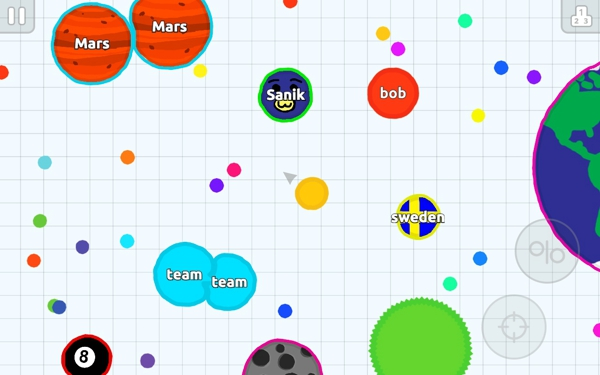
Positioning in Agar.io isn't about being in the right place at the right time — it's about controlling territory so that the right place comes to you. I think about Agar.io's map the way a real estate investor thinks about a city. Location, location, location.
The Center vs. Edge Debate
The center of the map has the highest food density. More pellets, more players, more action. It's where you go when you want to grow fast. It's also where you go to die. Every player on the server can reach the center, which means the center is a constant battleground.
I have a personal rule: I go to the center when I'm between 200 and 800 mass. Small enough to escape if things go wrong, big enough to eat the new spawns that congregate there. Once I cross 1,000 mass, I migrate to the edges. The edges have less food, but they have something more valuable: fewer threats. I can control a quadrant, eat the food that spawns there, and pick off stragglers without worrying about being surrounded.
Some players disagree with this approach. I know top players who live in the center permanently, relying on their split skills to handle multiple threats. That works if your mechanics are flawless. Mine aren't, so I play the percentages.
Corner Control
The four corners of the map are the most defensible positions in the game. You have wall protection on two sides, which means a predator can only approach from two directions instead of 360 degrees. If you're being chased and you can reach a corner, you've just halved the problem.
The counter-strategy: don't let your prey reach the corner. If you're hunting someone who's heading for a corner, cut them off early. Once they're in the corner, you need to commit to a direct approach, and a direct approach is exactly when they'll bait you.
The Minimap Discipline
I check the minimap every three to five seconds. Not occasionally — religiously. The minimap tells you where the big players are, where battles are happening, and where food clusters exist. When you're large, you can't afford to be surprised. A rival giant appearing from an unmonitored direction is the most common cause of death for leaderboard players.
Editor's Note: The zoom feature interacts with positioning in a way most players don't think about. When you're small, zoom in — you need precision to navigate tight spaces and grab individual pellets. When you're large, zoom out as far as possible. Your cell's exact position matters less than knowing where every threat and opportunity is. I've developed a habit of constantly adjusting zoom based on my size, and it's probably the single thing that improved my survival rate the most.
⚔️ Agar.io vs The Rest: How It Stacks Up Against Other Cell Games
Agar.io created the .io genre. That's not marketing speak — Matheus Valadares built it in 2015, and virtually every .io game since has borrowed from its formula. But borrowing isn't the same as matching, and after playing dozens of cell-eating and growth-based io games, I have strong opinions about how Agar.io compares to its competitors.
Agar.io vs Slither.io
Slither.io took Agar.io's core concept — grow by consuming, die if consumed — and mapped it onto a snake body. The fundamental difference is movement. In Agar.io, your cell moves as a single blob with momentum-based physics. In Slither.io, your snake has a body that follows your head, which means you can cut other players off by crossing their path.
This changes the entire strategic dynamic. In Agar.io, size is binary — you can eat someone or you can't, and the math is simple. In Slither.io, size is a trap — a long snake is powerful but also a bigger target, and a single mistake (touching another snake's body with your head) means instant death regardless of your size. I find Slither.io more punishing but less strategically deep. The optimal strategy in Slither.io is largely "boost to cut off, coil to trap," whereas Agar.io's split mechanics create a much wider range of tactical options.
That said, Slither.io's boost mechanic (sacrificing mass for speed) is something I wish Agar.io had. In Agar.io, you can eject mass with W to lose size and gain speed, but it's slow and inefficient. Slither.io's boost is instant and dramatic — it creates these incredible moments of high-speed interception that Agar.io's physics can't replicate.
Agar.io vs Diep.io
Diep.io started as an Agar.io clone but evolved into something closer to a top-down shooter. You control a tank, shoot shapes and other players, and upgrade your stats as you level up. The growth mechanic is still there — you get bigger and stronger — but combat is projectile-based rather than contact-based.
I bring up Diep.io because it solved a problem Agar.io has: late-game stagnation. In Agar.io, once you're massive, the game slows down. You can't chase anything, you're bleeding mass, and you're mostly waiting for someone to make a mistake. Diep.io's upgrade system means the game keeps evolving — new abilities, new playstyles, new strategies — even at max level. Agar.io's late game is genuinely boring by comparison, and I think that's the game's biggest flaw.
Agar.io vs Hole.io
Hole.io is a different beast entirely. You control a hole that swallows objects, growing larger to swallow bigger objects. It's Agar.io's consumption mechanic applied to a city environment. The key difference: Hole.io has a time limit. Matches end after two minutes, which means there's no late-game stagnation — the game is always building toward a climax.
I prefer Agar.io's open-ended format for competitive play. The lack of a time limit means matches can go as long as your skill allows, and the leaderboard provides a continuous feedback loop. But Hole.io's session-based design is arguably better for casual players who want a satisfying, complete experience in a few minutes.
What Agar.io Still Does Better Than Everyone
Splitting. Nobody has replicated Agar.io's split mechanic as well as Agar.io itself. The combination of offensive range, defensive vulnerability, and the 30-second recombine timer creates a risk-reward dynamic that no other io game matches. Every split is a commitment — you're betting your mass on your timing and reads. When it works, it's exhilarating. When it fails, it's devastating. That emotional swing is what keeps me coming back.
🤝 The Unspoken Rules: FFA Politics and Team Dynamics
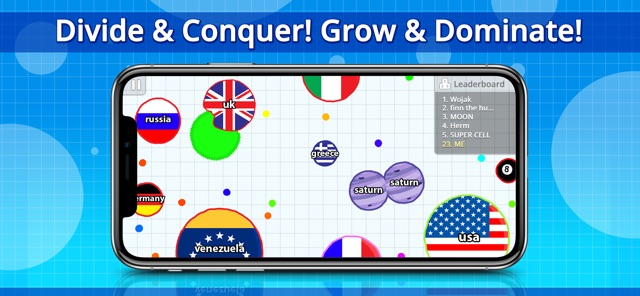
Agar.io has a social layer that the game itself never acknowledges. In FFA (Free-For-All), you're supposed to be alone — every cell for itself. In reality, players team up constantly. They feed each other mass, coordinate splits, and protect each other from larger threats. The community calls this "teaming," and it's the most controversial topic in Agar.io's player base.
Miniclip (Agar.io's publisher) added an anti-teaming algorithm that penalizes rapid mass exchange between players. If you feed someone too much mass too quickly, you start losing mass at an accelerated rate. The penalty is exponential — a 10,000-mass cell can drop to 500 in under a minute if the algorithm triggers. Top players have learned to manage this by "cooling down" — stopping all W-inputs for a period to reset the counter before resuming team play.
I have mixed feelings about teaming. On one hand, coordinated team play in FFA is genuinely impressive — watching four players execute a tricksplit (where one player splits multiple times toward a target while a teammate splits to eat the pieces and the target simultaneously) is like watching a choreographed dance. On the other hand, it ruins the experience for solo players who are trying to play the game as intended.
My advice: if you're playing FFA solo, assume everyone is teaming. Watch for players who seem to move together, feed each other, or never attack each other. When you identify a team, either avoid them or bait them into the anti-teaming penalty by forcing rapid mass exchanges. And if you want to team yourself, use Party Mode — that's what it's there for.
Pro Insight: In Team Mode (Red, Blue, Green), coordination is the entire game. The team that feeds mass to its smallest players — bringing them up to fighting size — wins. I've been on teams where one player hoarded 5,000 mass while teammates sat at 200. We lost. The teams that distribute mass evenly, protect their vulnerable players, and coordinate split attacks on rival teams' leaders? Those teams dominate. Ego loses games in Team Mode. Sharing wins them.
The Art of the Not-AFK Bait
One of my favorite FFA tactics: stop moving. Just stop. Put your cursor at the center of your cell and sit there. Other players will assume you're AFK — away from keyboard, an easy meal. They'll split toward you, committing their mass. The moment they split, you move. If you're close enough in size, their launched piece is now smaller than your full cell, and you eat it. If you're not close enough, you at least dodge the attack and reset.
This works because Agar.io players are greedy. The sight of a stationary cell is like chum in the water. I've baited players twice my size this way — they split to eat me, I dodge, their piece is now smaller than me, I eat their piece. It's deeply satisfying.
Server Selection Matters
Different Agar.io servers have different player populations, skill levels, and sometimes even slightly different mechanics. The North American servers tend to be aggressive and fast-paced. European servers have a reputation for more strategic, patient play. Asian servers — particularly the Japanese and Korean servers — are known for incredibly high-skill team play.
I recommend sticking to one server until you understand its meta. Each server develops its own culture: some are team-heavy, some are pure FFA, some have unspoken rules about what's fair play. Learning the server's culture is as important as learning the game's mechanics.
❓ Questions From the Server
Q: What's the fastest way to grow in Agar.io?
A: Scavenging. Position yourself near battles between large players, and when one dies, rush in to eat the fragments. A single successful scavenger run can net you more mass than ten minutes of pellet-eating. If no battles are happening, chain-split through pellet-dense areas in the center of the map.
Q: What's the difference between a pop split and a chain split?
A: A pop split uses a virus to explode a target so you can eat their fragments. A chain split is rapid sequential splitting to create a wide net of small cells for food collection. Pop splits are for combat; chain splits are for farming. They're completely different techniques that happen to both involve splitting.
Q: How do I escape a player twice my size?
A: You probably can't outrun them in a straight line — larger cells move slower, but they can split to close the distance. Your best options are: navigate toward a virus field (they won't follow), head for a map corner to limit their approach angles, or use the self-feed escape to surprise them when they commit. If none of those are available, accept that you're probably going to die and focus on respawning in a better location.
Q: Is Agar.io still active in 2026?
A: Absolutely. Agar.io maintains a massive player base across its official servers and community-run private servers. The game has been continuously updated since 2015, with new game modes, skins, and mechanics added regularly. It remains one of the most played browser games in the world.
Q: How does the anti-teaming system work?
A: The anti-teaming algorithm monitors the frequency and volume of mass exchanges (W-feeding) and rapid self-consumption (splitting and recombining). If your "mass exchange ratio" exceeds a threshold within a rolling 30-second window, you start losing mass at an accelerated rate. The penalty is exponential and can strip thousands of mass in seconds. To avoid it, stop all W-inputs and splitting for roughly 10-15 seconds to let the counter reset.
Q: What's the best size to maintain in FFA?
A: I aim for 1,000-3,000 mass. Large enough to eat most players, small enough to escape if things go wrong. Going beyond 5,000 mass makes you a target for every virus-shooter on the server, and the mass decay rate starts eating into your gains. Let someone else hold #1 — you'll live longer at #3 or #4.
Q: Should I use mouse or trackpad for Agar.io?
A: Mouse, without question. Trackpads lack the precision and speed needed for split timing and quick directional changes. If you're serious about improving, invest in a gaming mouse with low latency. The difference is night and day — I dropped my reaction time on split-escapes by roughly 30% after switching from a trackpad to a proper mouse.
Q: Can I play Agar.io competitively?
A: Agar.io doesn't have an official ranked mode or tournament circuit, but the community has built its own competitive scene. Private servers host organized matches with custom rules, and Discord communities run leaderboard challenges and team tournaments. If you want structured competition, search for Agar.io competitive Discord servers — there are several active ones with regular events.
Q: What are the best private server settings for practice?
A: Look for servers with slower mass decay (so your practice sessions last longer), moderate player counts (enough to simulate real conditions, not so many that it's chaos), and standard split mechanics. Avoid servers with modified mechanics like instant merge or unlimited split range — they teach bad habits that don't transfer to official servers.
Agar.io is a game that rewards patience, punishes greed, and never stops teaching you something new. I've been playing for years and I still learn something every session — usually from a mistake that costs me several thousand mass. The leaderboard is temporary. The skill is permanent. Split smart, position better, and maybe I'll see you on the server. I'll be the one hiding behind a virus.